

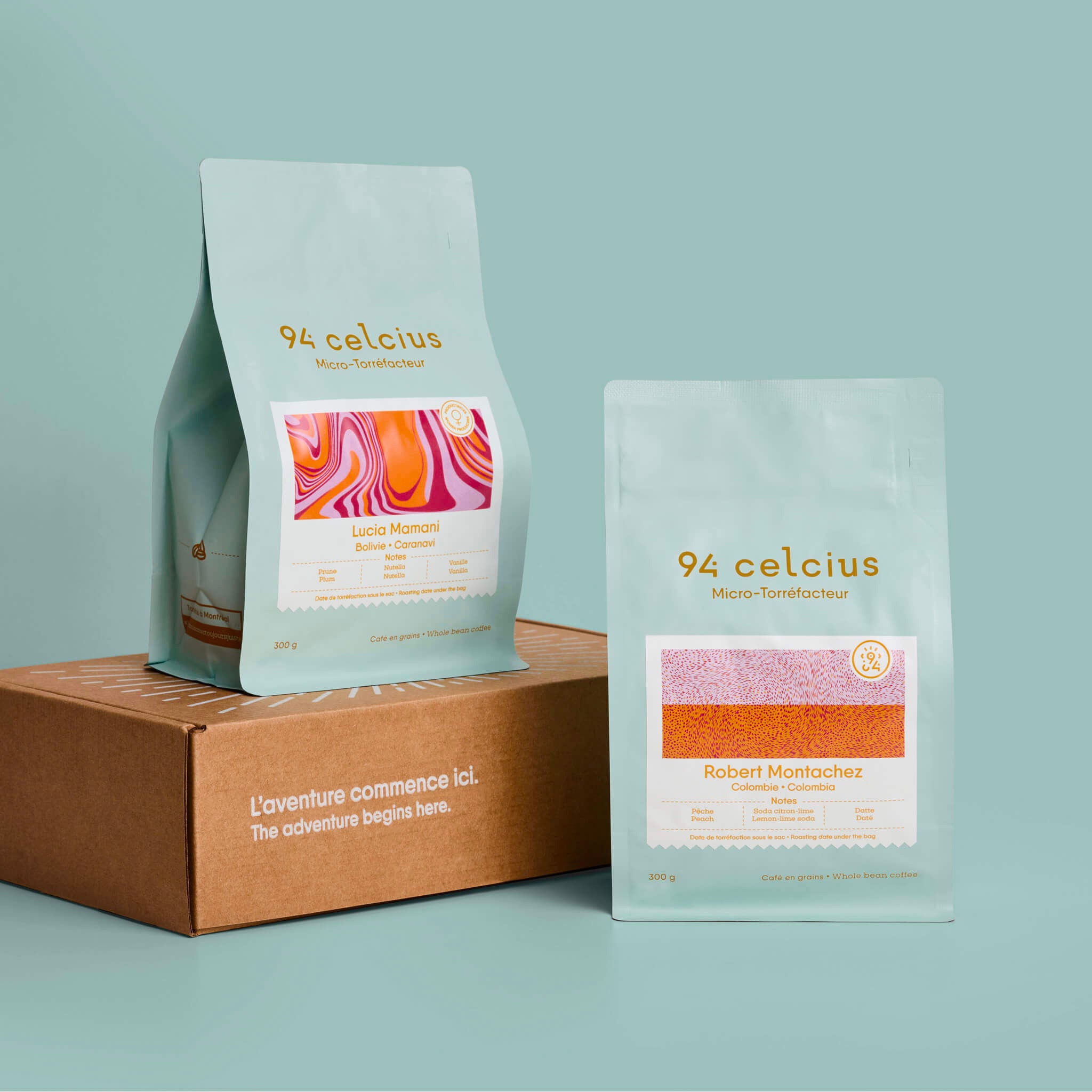




Brewing coffee seems simple, but achieving an exceptional cup requires precision. From selecting beans to extraction technique, every detail matters. This guide explores all brewing methods, decodes the science behind perfect extraction, and reveals barista secrets.
At 94 Celcius, a Montreal roaster specializing in freshly roasted specialty coffee, we believe that mastering brewing fundamentals transforms your daily coffee experience. This complete guide takes you from bean selection to the perfect cup.
1. The Fundamentals: Understanding Coffee Before Brewing
The Quality Triptych
Before even touching a coffee maker, three elements determine 70% of your final result:
Coffee Beans
-
Arabica: delicate aromas, floral and fruity notes, fine acidity, 1.2-1.5% caffeine
-
Robusta: powerful body, chocolate/caramel notes, pronounced bitterness, 2-2.5% caffeine
-
Blends: balance between aromatic finesse and power
Golden Rule: Always choose freshly roasted whole bean coffee (less than 3 weeks post-roast) and grind just before brewing. Volatile aromas escape within 15 minutes after grinding.
To explore different aromatic profiles, discover our signature blend collection that harmonizes multiple exceptional origins for balance and complexity.
Adapted Grind Size
Investing in a quality grinder is essential for controlling particle size and achieving optimal extraction.
| Brewing Method | Grind Size | Why |
| Espresso | Extra fine (powder) | Fast extraction under pressure |
| Drip coffee maker | Medium (sugar) | Balanced extraction/flow |
| French press | Coarse (salt) | Avoids sediment and bitterness |
| Moka pot | Fine to medium | Withstands steam pressure |
| Cold brew | Extra coarse | Extended cold infusion |
Water: The Forgotten Ingredient
Your coffee is 98% water. Water with a pH between 6.5 and 7.5 positively influences taste—too acidic and coffee becomes sour, too alkaline and it turns bitter.
Ideal Water Checklist:
-
Filtered water (Brita pitcher or integrated filter)
-
Temperature between 90-96°C (never boiling)
-
Low chlorine and limestone content
To perfect your water quality, Third Wave Water packets transform your tap water into optimal water for coffee extraction, revealing all the subtleties of your beans.
2. The Perfect Equation: Ratios, Temperature, and Timing
The Universal Coffee-to-Water Ratio
Base formula: 60g of coffee per 1L of water (i.e., 1:17)
Adjustments according to your preferences:
-
Strong coffee: 1:15 (65-70g/L)
-
Balanced coffee: 1:17 (60g/L) ← recommended
-
Light coffee: 1:19 (50-55g/L)
Practical tip: One level tablespoon of ground coffee = approximately 6-7g. For optimal precision, use a dosing scale—the barista's essential tool.
Precise Temperature
The ideal water temperature for coffee brewing is between 195°F and 205°F or 90°C to 96°C.
Why it's critical:
-
Too hot (>96°C): burns essential oils → excessive bitterness
-
Too cold (<88°C): under-extraction → acidic and flat coffee
Without a thermometer: Boil water, then let it rest for 60-90 seconds. For perfect control, invest in a temperature-controlled kettle.
Extraction Timing by Method
| Method | Extraction Time | Success Sign |
| Espresso | 25-30 seconds | Steady flow ending in thin stream (mouse tail) |
| Drip coffee maker | 3-4 minutes | Constant flow, no overflow |
| French press | 4 minutes | Grounds well settled at bottom |
| Moka pot | 4-5 minutes | Gentle gurgling, no boiling |
| Cold brew | 12-24 hours | Concentration according to duration |
| Pour-over (V60/Chemex) | 3-4 minutes | Spiral pouring to saturate evenly |
3. All Brewing Methods Compared
Method 1: Drip Coffee Maker (Electric)
Principle: Water passes through ground coffee in a paper filter.
Detailed Steps:
-
Rinse the paper filter with hot water to eliminate paper taste
-
Add 60g of ground coffee (medium grind) per 1L of water
-
Pour water into the reservoir
-
Start the machine
-
Serve immediately (coffee loses aromas on the hot plate)
Recommended Coffees: Our filter coffee collection offers fruity, floral, and bright profiles specially roasted for gentle methods.
Advantages: Simple, fast, large quantities, inexpensive
Disadvantages: Less control, coffee can burn on the plate
Ideal for: Office, large family, busy mornings
Method 2: French Press
Principle: Total coffee infusion in hot water.
Detailed Steps:
-
Preheat the French press with hot water
-
Add coarse ground coffee (70g/L for strong coffee)
-
Pour water at 93-96°C, wait four minutes, then press the plunger slowly
-
Serve immediately (don't let it steep longer)
Pro technique: Stir gently after 1 minute to break the crust that forms on the surface.
Advantages: Rich body, preserved oils, total control
Disadvantages: Too fine grind causes sediment and bitterness
Ideal for: Slow tasting, specialty coffee
Method 3: Moka Pot (Italian)
Principle: Steam pressure pushes water through coffee.
Detailed Steps:
-
Fill the lower chamber with pre-heated water without drowning the pressure valve to avoid bitterness
-
Fill the funnel completely with medium ground coffee and level without tamping
-
Screw both parts together
-
Place on medium heat (never high)
-
Monitor during heating and absolutely avoid boiling as it alters flavor
-
Remove from heat as soon as it gurgles
Advantages: Intense coffee, iconic design, economical
Disadvantages: Requires monitoring, delicate cleaning
Ideal for: Espresso lovers without a machine
Method 4: Espresso (Pressure Machine)
Principle: The principle of espresso boils down to one word: pressure.
Detailed Steps:
-
Preheat the machine and cup
-
Grind 18-20g of coffee (extra fine grind)
-
Tamp evenly with 15kg of pressure
-
Extraction should happen in two stages with pre-infusion for a few seconds before sending full pressure
-
Coffee should flow between 25 and 30 seconds for a 5cl cup in a steady stream
Recommended Coffees: Discover our espresso blends with chocolatey and caramelized profiles, specially designed for short extraction.
Signs of Good Espresso:
-
Thick golden crema (2-3mm)
-
Flow in a "mouse tail"
-
Intense aromas from the first seconds
Advantages: Maximum concentration, versatility (base for latte, cappuccino)
Disadvantages: High cost, learning curve
Ideal for: Purists, Italian coffee lovers
To perfect your espressos, explore our barista accessories: tampers, dosers, and professional extraction tools.
Method 5: Pour-Over (V60/Chemex/Dwell Dripper)
Principle: Controlled manual pouring over ground coffee in a conical filter.
Detailed Steps:
-
Place paper filter and rinse it
-
Add 30g of coffee (medium-fine grind) per 500ml of water
-
First bloom pour: pour twice the amount of water as coffee and wait 30-45 seconds for coffee to bubble and foam
-
Resume pouring in a spiral for 3 minutes to saturate evenly
-
Let it fully drain
Explore our precision drippers to master this extraction technique.
Advantages: Aromatic clarity, precise control, spectacular visual
Disadvantages: Requires practice, one cup at a time
Ideal for: Specialty coffees, complex aromatic profiles
Method 6: Cold Brew
Principle: Cold water drips onto grounds and absorbs aromas before flowing into a carafe.
Simplified Method (without special equipment):
-
Pour 1 cup of ground coffee (coarse grind, 100g) per 4 cups of cold water in a pitcher
-
Stir well to wet all grounds
-
Cover and place in refrigerator for 12-24 hours
-
Filter slowly through a coffee filter or fine strainer
Advantages: Zero acidity, extreme smoothness, keeps for 2 weeks
Disadvantages: Long preparation time
Ideal for: Sensitive stomachs, iced coffees, batch prep
Method 7: Turkish Coffee (Cezve/Ibrik)
Principle: Direct decoction in a copper pot.
Detailed Steps:
-
Preheat your cezve with hot water to maintain constant temperature
-
Pour hot water (but not boiling) and add extra fine ground coffee, approximately 7-8 grams per 100ml of water
-
Add sugar if desired (now, not after)
-
Let steep for 4-5 minutes stirring regularly for homogeneous infusion
-
Don't let water boil, remove from heat as soon as foam begins to form to preserve aromas
-
Pour carefully into cups and leave the last sip which is generally stronger
Advantages: Cultural ritual, very strong coffee, spices possible
Disadvantages: Grounds in cup, delicate technique
Ideal for: Authentic experience, after-meal
Comparative Method Chart
| Method | Difficulty | Time | Intensity | Body | Acidity | Equipment | Price |
| Electric drip | ⭐ | 5 min | Medium | Light | Medium | $30-100 | $ |
| French press | ⭐⭐ | 6 min | Strong | Rich | Low | $20-80 | $ |
| Moka pot | ⭐⭐ | 8 min | Strong | Medium | Medium | $25-70 | $ |
| Espresso | ⭐⭐⭐⭐⭐ | 2 min | Very strong | Very rich | Variable | $200-3000 | $$$$ |
| Pour-over | ⭐⭐⭐ | 5 min | Medium | Light | High | $15-150 | $$ |
| Cold brew | ⭐ | 12-24h | Smooth | Light | None | $10-50 | $ |
| Turkish coffee | ⭐⭐⭐ | 7 min | Very strong | Thick | Low | $15-60 | $ |
4. Techniques Without a Coffee Maker (Emergency Solutions)
Method A: Pot Coffee
Put 250ml of water in a pot, add 1 tablespoon of ground coffee, stir regularly, cover and bring the mixture to a boil.
Complete Steps:
-
Pour cold water + ground coffee in the pot
-
Bring to boil while stirring
-
Reduce heat and let steep for 2-3 minutes covered
-
Remove from heat and let rest for 2 minutes (grounds sink to bottom)
-
Pour gently into cup without stirring
Method B: Improvised Filter
Paper towel or a clean cloth can replace a coffee filter as it's made in the same style.
Filter Alternatives:
-
3 stacked paper towels
-
Clean cotton/linen/hemp cloth
-
Fine strainer + gauze
Place filter around cup, add ground coffee, boil water, wait for it to cool to 90-95°C, then add it gently to the coffee.
Method C: Direct Infusion (Cowboy Method)
Boil water, take a cup, add 1 tablespoon of coffee per 250ml, pour boiling water, let rest for a few minutes, then pour through a strainer over a second cup.
Tip: Add a clean crushed eggshell—it catches fine particles and clarifies the coffee.
5. Mistakes to Absolutely Avoid
Mistake #1: Using Boiling Water
Consequence: Burns coffee → pronounced bitterness + destroyed aromas
Solution: Wait 60-90 seconds after boiling (90-96°C ideal)
Mistake #2: Grinding Coffee Too Far in Advance
Consequence: Rapid oxidation → loss of 70% of aromas in 15 minutes
Solution: Always grind just before brewing
Mistake #3: Wrong Coffee-to-Water Ratio
Consequence: Coffee too weak or too strong, unbalanced extraction
Solution: Weigh with a scale (60g/L = universal base)
Mistake #4: Reusing Paper Filters
Consequence: Rancid oils + residues → cardboard taste
Solution: Always use a new filter
Mistake #5: Leaving Coffee on the Hot Plate
Consequence: Burnt coffee after 20 minutes
Solution: Transfer immediately to a preheated thermos
Mistake #6: Not Cleaning Equipment
Consequence: Rancid oils + ground accumulation → persistent bitter taste
Solution: Complete cleaning after each use, monthly descaling
Mistake #7: Tamping Coffee in a Moka Pot
Consequence: Steam blockage → explosion or burnt coffee
Solution: Fill the funnel, level, never tamp
6. Adjusting Coffee to Your Palate
Problem → Solution
| Your coffee is... | Probable Cause | Adjustment |
| Too bitter | Water too hot / over-extraction / grind too fine | Lower temperature / shorten time / coarser grind |
| Too acidic | Under-extraction / water too cold | Increase temperature / extend time / finer grind |
| Too weak | Not enough coffee | Increase ratio (65-70g/L) |
| Too strong | Too much coffee | Reduce ratio (50-55g/L) |
| Watery, flat | Inappropriate grind / extraction too fast | Finer grind / extend time |
| Sediment in cup | Grind too fine for method | Coarser grind |
7. The Science of Extraction
The Three Extraction Phases
-
Acidic phase (0-30%): Chlorogenic acids, citrus notes
-
Balanced phase (30-70%): Sugars, body, complex aromas ← IDEAL ZONE
-
Bitter phase (70-100%): Tannins, concentrated caffeine, astringency
Objective: Stop extraction in the balanced phase.
Extraction Variables (in order of impact)
-
Grind: Finer = more extraction, faster
-
Temperature: +5°C = +10% extraction
-
Contact time: Proportional to extraction
-
Agitation: Accelerates extraction (stirring, turbulence)
-
Pressure: Only for espresso (9 bars optimal)
The Perfect Scientific Recipe
For 1L of filter coffee:
-
60g of ground coffee (medium grind, like granulated sugar)
-
1L of water at 93°C (boiling then 90 seconds rest)
-
Pre-infusion: 100ml of water, wait 30 seconds (blooming)
-
Pouring: remaining 900ml in 3 minutes
-
Target TDS (Total Dissolved Solids): 1.15-1.35%
From Average Coffee to Exceptional Coffee
The difference between ordinary coffee and an exceptional cup doesn't lie in expensive equipment, but in mastering the details:
-
Fresh quality beans (< 3 weeks post-roast)
-
Grind adapted to your method
-
Filtered water between 90-96°C
-
Precise 1:17 ratio (adjustable by taste)
-
Timed extraction
-
Clean equipment
The barista secret: Consistency. Note your settings (weight, temperature, time), adjust one variable at a time, and repeat until you find your perfect recipe.
Your next coffee will no longer be a morning routine, but a mastered ritual.
Discover our complete collection of specialty coffees freshly roasted to maximize every cup. To perfect your technique, explore our barista equipment and our essential accessories.